Historic Redheads: Influence Across the Centuries
Reading time: 10 minutes
In 1588, Queen Elizabeth I had herself immortalized in portraits with flaming red hair while she defeated the Spanish Armada. Her copper mane became a symbol of power, independence and strategic brilliance. Historic redheads have ruled empires, sparked revolutions and shaped cultural movements down the centuries. Their red hair was never just a biological trait, but often a deliberately staged signal of power.
While redheaded women today often get special attention in dating, their historical predecessors were rulers, artists and rebels. The history of flame-colored hair is a history of female power in a male-dominated world. These women used their uniqueness as a weapon and a tool.
Queens and Rulers in the History of Flame-Colored Hair
Elizabeth I of England ruled from 1558 to 1603 and made her red hair a trademark of dynastic legitimacy. After taking the throne, she had dozens of wigs made in bright copper red, even as her natural hair thinned with age. This strategic image policy visually tied her to her father Henry VIII, who was also a redhead. Historians like David Starkey document that Elizabeth deliberately chose red tones in clothing and jewelry to strengthen her presence.
The genetic background of redheaded rulers can already be found in the origin of red hair through the MC1R gene mutation. This genetic peculiarity accounted for about 1-2% of the European population and was often interpreted as a divine sign.
Boudicca, queen of the Iceni, led a bloody uprising against the Roman occupation of Britain in 60 AD. The Roman historian Cassius Dio described her as "very tall, with a fierce look and a harsh voice, with a great mass of tawny hair that fell to her hips". The Romans read her copper mane as a sign of barbaric wildness, while the Britons revered it as a symbol of divine selection. She conquered Camulodunum (today's Colchester) and, by historical estimates, killed about 70,000 Roman settlers before her uprising was crushed.
Mary, Queen of Scots had chestnut-red hair that she showcased with elaborate hairstyles. Born in 1542, she became queen at just six days old. Her red hair was regarded as an exotic mark of beauty at the French court, where she grew up. After returning to Scotland in 1561, she skillfully used her appearance in power politics against Elizabeth I of England.
Famous Redheads in Art and Culture
The Italian Baroque artist Artemisia Gentileschi painted herself with copper-red hair in 1638 as an allegory of painting. Born in Rome in 1593, she was one of the first women to gain admission to the Accademia di Arte del Disegno in Florence. Her self-portraits deliberately show her flame-colored hair as a sign of artistic passion. Art historians at the National Gallery London stress that Gentileschi used her red hair to set herself apart from male colleagues and to symbolize female strength.
Sarah Bernhardt, born in Paris in 1844, revolutionized European theater of the 19th century. Her curly copper-red mane became her trademark and appeared on countless posters by Alphonse Mucha. Bernhardt played lead roles in over 70 stage productions and deliberately used her striking appearance for publicity. She was one of the first actresses to market her hair color commercially - hairdressers offered "Sarah Bernhardt red" as a sought-after hair color.
The special attraction of copper hair also shows in historical ideals of beauty. While redheaded women in the Middle Ages were often associated with witchcraft, in the Renaissance they were seen as the embodiment of ideal femininity.
Influential Figures and Scientific Pioneers
Florence Nightingale, born in 1820, is considered the founder of modern nursing. Historical records describe her as redheaded with pale skin. During the Crimean War in 1854, she reorganized the military hospital system and cut the mortality rate from 42% to 2%. Nightingale developed statistical methods for recording health data and wrote over 200 books and pamphlets. Her scientific approach revolutionized medicine, and in 1859 she became the first woman admitted to the Royal Statistical Society.
Emily Dickinson, born in Massachusetts in 1830, wrote over 1,800 poems, of which only ten were published in her lifetime. Contemporary descriptions mention her auburn (chestnut-red) hair. Dickinson lived in seclusion, but her poetic language influenced generations of American poetry. She experimented with unconventional rhyme schemes and punctuation in ways that weren't recognized until the 20th century.
Katharine Hepburn had naturally reddish-brown hair and shaped Hollywood from the 1930s into the 1990s. She won four Oscars for best actress - a record that still stands today. Hepburn played strong, independent female roles at a time when Hollywood mostly portrayed women as passive beauties. Her famous saying "If you obey all the rules, you miss all the fun" became the motto of confident women.
Historical Women Between Myth and Reality
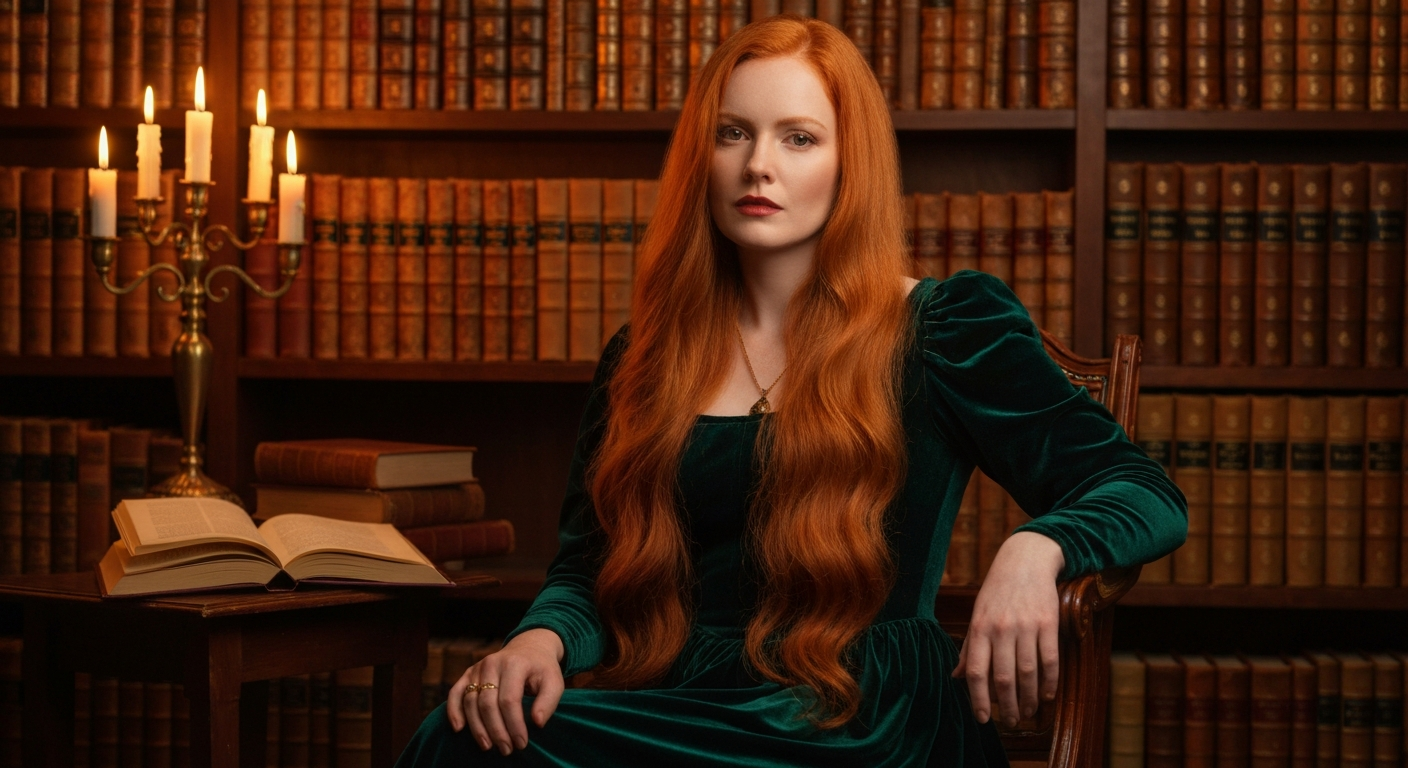
Mary Magdalene has traditionally been depicted with long red hair in Christian iconography since the Middle Ages, although biblical texts never mention her hair color. This artistic convention arose in the 13th century and linked red hair with sin, penance and ultimately redemption. Artists like Titian painted her in 1533 with a flowing copper-red mane. This depiction influenced European perceptions of redheaded women for centuries.
Cleopatra VII of Egypt is described as redheaded in some historical sources, though this remains disputed. The Greek historian Plutarch mentions her "captivating presence" and "the color of her face", which some historians interpret as a hint of reddish hair. As a ruler from 51 to 30 BC, she spoke nine languages and conducted political negotiations with Caesar and Mark Antony. Regardless of her actual hair color, she was often depicted with red hair in art history.
Lucrezia Borgia, born in 1480, belonged to the notorious Borgia family and, according to contemporary accounts, had hair that shimmered golden red. She was married three times for political reasons and served as regent of the Vatican during the absence of her father, Pope Alexander VI. Contrary to her reputation as a poisoner, historical research shows her as an educated patron who supported artists and poets. Her red mane became a symbol of seduction and danger in Renaissance literature.
Redheaded Rebels and Revolutionaries
Rosa Luxemburg, born in Poland in 1871, had dark reddish-brown hair. As a co-founder of the Communist Party of Germany, she shaped the socialist movement with brilliant theoretical writings. Luxemburg earned her doctorate in 1897 with a dissertation on Poland's industrial development and became a leading intellectual of the German labor movement. She was murdered in 1919 during the Spartacist uprising. Her writings have influenced left-wing movements to this day.
Grainne Mhaol (Grace O'Malley), born around 1530 in Ireland, was a pirate chief and clan chief. Legends describe her with fiery red hair that she cut short like a man. She commanded a fleet of 20 ships and carried out raids on English and Irish coastal settlements. In 1593 she sailed to London to meet Queen Elizabeth I in person and negotiate over her imprisoned son. The meeting of two redheaded rulers became legendary, with O'Malley communicating in Latin because she spoke no English.
The distinctive character traits of redheaded women were historically often interpreted as expressions of temperament, passion and unconventionality. Some historic redheads deliberately used these stereotypes to their advantage.
Scientific Findings About Historic Redheads
Genetic research from the University of Oxford shows that the MC1R gene, responsible for red hair, was already present in Neanderthals. A study published in the journal Science in 2007 showed that at least some Neanderthals were redheaded and fair-skinned. This means that red hair has existed in the human population for at least 50,000 years.
Historical DNA analyses of European mummies and skeletons prove the prevalence of red hair in different eras. Researchers at the University of Copenhagen found in 2018 that redheaded Vikings were more common than long assumed. The analysis of over 400 Viking skeletons showed that about 6% carried genetic markers for red hair.
The National Human Genome Research Institute documents that redheaded people react differently to pain because of their genetic peculiarity. They need on average 20% more anesthesia during medical procedures. This biological peculiarity may have given historic redheads a higher pain tolerance in extreme situations. Learn more in our article on pain sensitivity in redheads.
The Modern Meaning of Historical Role Models

Historic redheads inspire redheaded women around the world today. They show that red hair was never an obstacle, but often an advantage. In the modern dating world, redheaded women are considered especially attractive and unique. Psychological studies from the University of Hamburg from 2019 show that men perceive redheaded women as more confident and more interesting.
The historical success stories of redheaded women offer potential for identification. They demonstrate how supposed otherness can become strength. In the context of sugar dating, modern redheaded women use their distinctiveness strategically, much as historical rulers used their hair color as a symbol of power.
Cultural representation has changed. While redheaded women experienced persecution in the Middle Ages, today they are celebrated. We also owe this development to the historic redheads who broke through stereotypes with their achievements.
Practical Inspiration for Redheaded Women Today
From Elizabeth I, modern redheaded women can learn to stage their hair color deliberately. The queen chose clothing colors that brought out her copper hair at its best - above all white, black and shades of green. These color combinations work just as well today as in the 16th century.
Sarah Bernhardt's self-marketing shows how important personal branding is. She made her red curls an unmistakable trademark. In the modern dating context, redheaded women can do something similar by highlighting their natural hair color as their USP.
Florence Nightingale's combination of expertise and assertiveness demonstrates timeless principles. Competence paired with confident presence opens doors - then as now. Redheaded women looking for demanding partners benefit from this attitude especially.
Styling Tips Inspired by Historical Role Models
- Wear shades of green and blue like Elizabeth I to make red hair glow at its brightest
- Go for dramatic updos like Mary, Queen of Scots, which emphasize face and neck
- Combine natural makeup with bold lips like Sarah Bernhardt for classic elegance
- Use gold accessories instead of silver to strengthen warm undertones
- Experiment with loose waves like Grace O'Malley for confident nonchalance
Frequently Asked Questions About Historic Redheads
Why were redheaded women often persecuted in history?
In the Middle Ages and the early modern period, European superstition linked red hair with witchcraft and diabolical influence. This link arose partly from the rarity of the hair color (only 1-2% of the population) and biblical misinterpretations. During the witch hunts between 1450 and 1750, redheaded women were disproportionately accused, as historical court records from Germany and Scotland show.
Which historic redhead had the greatest political influence?
Elizabeth I of England exerted the most lasting political influence. Her 45-year reign (1558-1603) established England as a European great power, defeated the Spanish Armada in 1588 and fostered the Elizabethan era with Shakespeare and the colonization of North America. Her foreign policy shaped Europe for centuries.
Were there redheaded rulers outside Europe?
Documented cases are rare, since the MC1R gene is mainly found in northern European populations. A few Chinese sources mention Central Asian female rulers with "red hair", but these descriptions are historically hard to verify. The genetic distribution concentrates on Celtic and Germanic populations.
How did historic redheads use their hair color strategically?
Elizabeth I had wigs made in bright red to visualize dynastic legitimacy. Sarah Bernhardt made her copper hair a trademark through targeted press photos. Artemisia Gentileschi painted herself with emphasized red to symbolize artistic passion. They transformed a biological peculiarity into a visual instrument of power.
Which modern celebrities draw on historic redheads?
Jessica Chastain points to Elizabeth I as inspiration for confident role choices. Christina Hendricks cites Sarah Bernhardt as a model for marketing her red hair. Emma Stone named Lucille Ball (the redheaded comedy pioneer of the 1950s) as an influence on her career decisions. These connections show the lasting relevance of historical role models.
Conclusion: The Timeless Power of Flame-Colored Hair
Historic redheads impressively prove that red hair was more than a biological trait in every era. From Elizabeth I through Florence Nightingale to Rosa Luxemburg, influential women used their striking hair color as a strategic tool. They ruled empires, revolutionized science and art, led rebellions and shaped cultural movements. Their stories show that supposed otherness can become the greatest strength.
For modern redheaded women, these historical role models offer valuable inspiration. Whether in dating, at work or in the sugar dating context, deliberately staging your own distinctiveness opens doors. The scientific findings about the MC1R gene and the historical spread of red hair underscore the genetic continuity of this fascinating trait. Historic redheads paved the way for a world in which flame-colored hair is seen today as a sign of beauty, confidence and individuality.
Discover your own power as a redheaded woman and let these impressive historical figures inspire you. Use your natural distinctiveness as an advantage - just like the redheads who made history.